
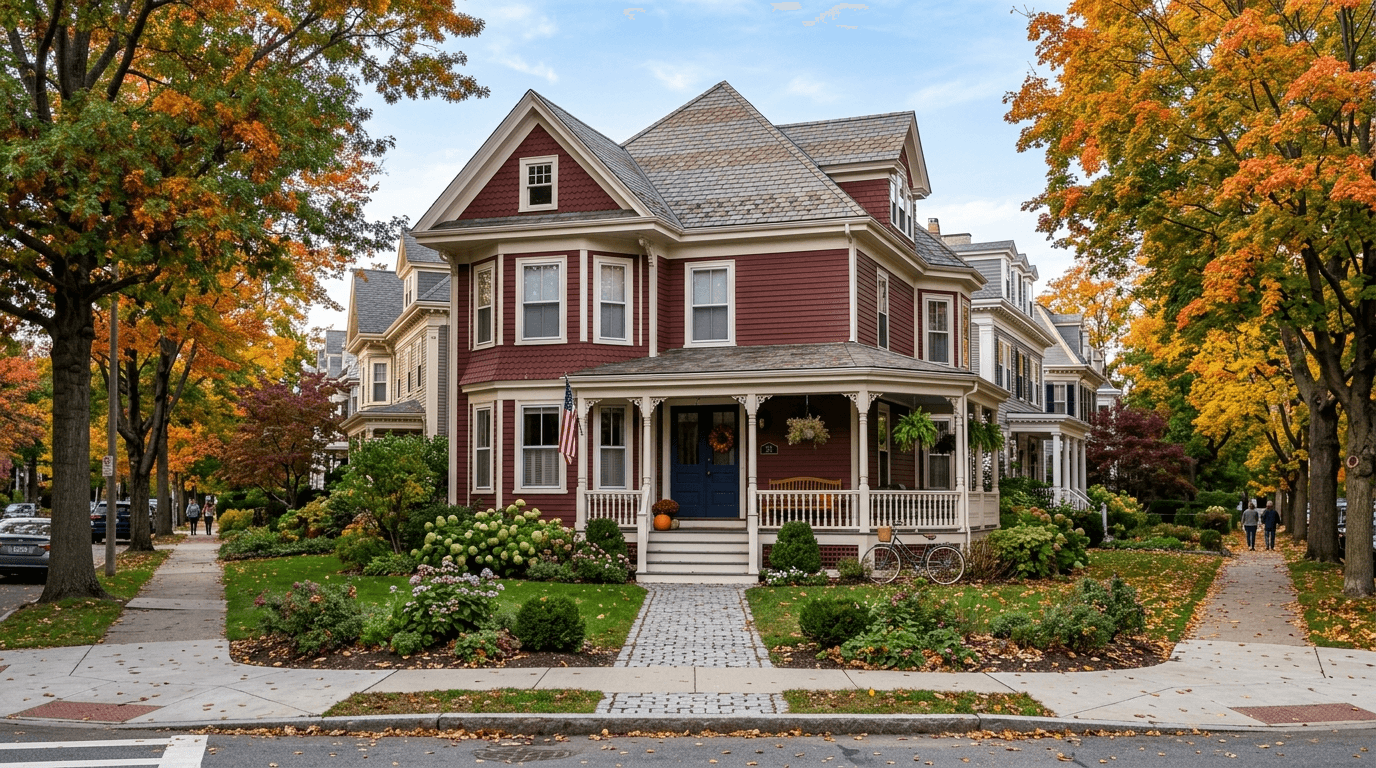
Why Are Cambridge Move-Up Buyers Competing With Developers for Houses?
Key Takeaways
•The short answer: Cambridge's single-family squeeze is structural, not seasonal. Zoning reform now allows up to six stories citywide, so big-lot houses are priced partly as building sites.
•What changed: Active single-family listings are far outnumbered by condos — and single-family is the only property type in the city selling above asking.
•The bottom line: Don't treat your sale and purchase as two separate deals. Line up bridge financing — a short-term loan that lets you buy before your current home sells — and hunt where developer math fails.
If you're trying to move up in Cambridge, the frustration is real. The largest houses now have a second audience: developers.
Councilor Burhan Azeem put the scale plainly. "We went from a place where 85 percent of our city was nonconforming beforehand... to now allowing up to six stories anywhere in the city." Nonconforming means built in a way today's zoning code would not allow.
Why Does a Developer Value Your Dream House Differently?
A developer isn't buying bedrooms; he's buying how much can legally be built on the lot. Larger houses sit on larger lots, where added height matters most — so your competition may not be another family.
This is also the tightest part of the market: 19 single-family homes active, compared with 118 condos.
Cambridge Active Listings by Property Type
A property-type comparison of active Cambridge listings year to date as of March 30, 2026.
| Series | Label | Value |
|---|---|---|
| Active Listings | Single Family | 19 |
| Active Listings | Condo | 118 |
| Active Listings | Multi-Family | 24 |
Fewer choices mean less room to negotiate. Cambridge single-family homes sold at 102.04% of list price — the only property type in the city that sold above asking.
Cambridge Sale-to-List Ratio by Property Type
A comparison of average sale price as a percentage of list price by Cambridge property type year to date as of March 30, 2026.
| Series | Label | Value |
|---|---|---|
| Sale Price as % of List | Single Family | 102.04% |
| Sale Price as % of List | Condo | 98.83% |
| Sale Price as % of List | Multi-Family | 96.86% |
Doesn't Upzoning Add More Housing?
Here's the strongest version of that objection: six stories citywide should eventually produce thousands of new homes and ease the pressure. Fair enough — citywide supply should improve.
But Cambridge is already a multifamily city. Thirty-five percent of its residential buildings hold nearly 80% of its units, according to the Cambridge Community Development Department. Added height gets built as apartments and condos, not detached houses, so new supply lands on a different rung than the one you're climbing. More condos do nothing for single-family inventory — and on the biggest lots, they can actually push up the land value you're bidding against.
Will Developers Really Outbid Families?
Here's the honest pushback: at a multimillion-dollar single-family median, with construction costs well above pre-pandemic levels, a teardown usually doesn't pencil out. So why worry about developers at all?
Mostly right. On most Cambridge parcels, redevelopment fails — lots are small, the existing house is expensive, and inclusionary rules requiring below-market units kick in on larger projects. Ask your agent about current thresholds.
What matters is the narrow case. On unusually large lots, added height can raise what the land is worth to a builder enough to outbid a family. Ask about your target lot, not the market as a whole.
Is Expanding in Place a Better Option?
Sometimes, with caveats. Azeem notes that roughly 85 percent of the city was nonconforming before the change, so some owners now have more room to enlarge.
But zoning permission isn't a building permit, construction costs have climbed sharply since before the pandemic, and you'd live inside the project for months. Renovation isn't a substitute for a larger house — it fits best when the space you need is modest and your location is already right.
How Should You Sequence a Move-Up Right Now?
•Line up financing before you list. Secure bridge financing or a post-closing occupancy agreement — a deal that lets you stay in your sold home briefly after closing. A contingent offer, one that depends on selling your own home first, can lose to a cash buyer.
•Hunt where developer math fails. Look at smaller lots, homes that already use most of their allowed size, and houses whose value comes from condition and charm rather than land.
•Don't assume waiving the home inspection wins the deal. Ask your agent what Massachusetts currently allows before you write an offer.
Sarah Gustafson of the Massachusetts Association of REALTORS® points to other levers: "A buyer can present an attractive offer to the seller using other terms such as price, closing date, etc."
What Should You Do Next?
The goal isn't just to find a house — it's to find the right one before a different buyer pool sets the price.
Ask for a move-up strategy review — neighborhood by neighborhood, lot by lot — before you list.